
Whisper AI
About Whisper AI
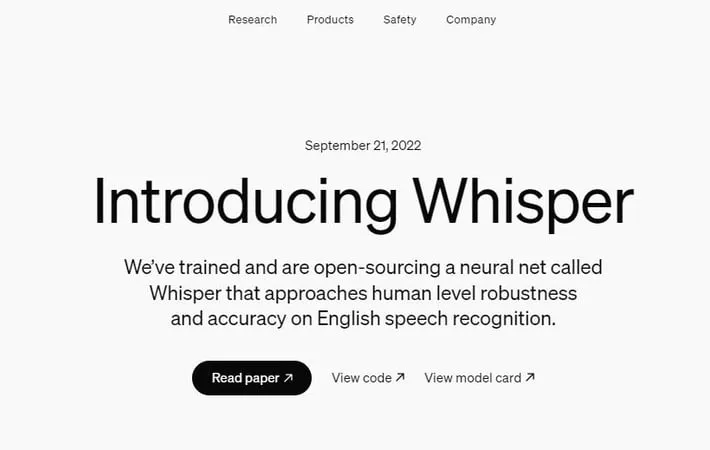
Whisper is an artificial intelligence model developed by OpenAI for automatic speech recognition (ASR). Released in September 2022, Whisper was trained on 680,000 hours of multilingual and multitask supervised data collected from the web. It can transcribe speech in multiple languages, translate speech to English, and identify the language being spoken. OpenAI has open-sourced both the model and inference code to enable further research and development of speech processing applications.
Key Features
Whisper AI is an advanced automatic speech recognition (ASR) system developed by OpenAI. It is trained on 680,000 hours of multilingual and multitask supervised data, resulting in improved robustness to accents, background noise, and technical language. Whisper can transcribe speech in multiple languages, translate to English, and perform tasks like language identification and phrase-level timestamps. It uses a simple end-to-end Transformer-based encoder-decoder architecture and is open-sourced for further research and application development. Multilingual Capability: Supports transcription and translation across multiple languages, with about one-third of its training data being non-English. Robust Performance: Demonstrates improved robustness to accents, background noise, and technical language compared to specialized models. Multitask Functionality: Capable of performing various tasks including speech recognition, translation, language identification, and timestamp generation. Large-scale Training: Trained on 680,000 hours of diverse audio data, leading to enhanced generalization and performance across different datasets. Open-source Availability: Models and inference code are open-sourced, allowing for further research and development of applications.
Use Cases
Transcription Services: Accurate transcription of audio content for meetings, interviews, and lectures across multiple languages. Multilingual Content Creation: Assisting in the creation of subtitles and translations for videos and podcasts in various languages. Voice Assistants: Enhancing voice-controlled applications with improved speech recognition and language understanding capabilities. Accessibility Tools: Developing tools to assist individuals with hearing impairments by providing real-time speech-to-text conversion. Language Learning Platforms: Supporting language learning applications with accurate speech recognition and translation features.
Pros
High accuracy and robustness across diverse audio conditions and languages Versatility in performing multiple speech-related tasks Open-source availability promoting further research and development Zero-shot performance capability on various datasets
Cons
May not outperform specialized models on specific benchmarks like LibriSpeech Requires significant computational resources due to its large-scale architecture Potential privacy concerns when processing sensitive audio data
How to Use
Install Whisper: Install Whisper using pip by running: pip install git+https://github.com/openai/whisper.git Install ffmpeg: Install the ffmpeg command-line tool, which is required by Whisper. On most systems, you can install it using your package manager. Import Whisper: In your Python script, import the Whisper library: import whisper Load the Whisper model: Load a Whisper model, e.g.: model = whisper.load_model('base') Transcribe audio: Use the model to transcribe an audio file: result = model.transcribe('audio.mp3') Access the transcription: The transcription is available in the 'text' key of the result: transcription = result['text'] Optional: Specify language: You can optionally specify the audio language, e.g.: result = model.transcribe('audio.mp3', language='Italian')
Official Website
Visit https://openai.com/index/whisper/ to learn more.