
Understanding Generative vs Discriminative Machine Learning Models: Key Concepts and Practical Use Cases
Introduction
Machine learning models can be broadly categorized based on how they understand and interpret data. Two fundamental paradigms in supervised and unsupervised learning are generative models and discriminative models. Both are widely used in AI systems, but they serve different purposes and rely on distinct mathematical principles. In this article, we’ll unpack what makes these two categories unique, compare their strengths and limitations, and illustrate practical examples where each excels.
What Are Generative Models?
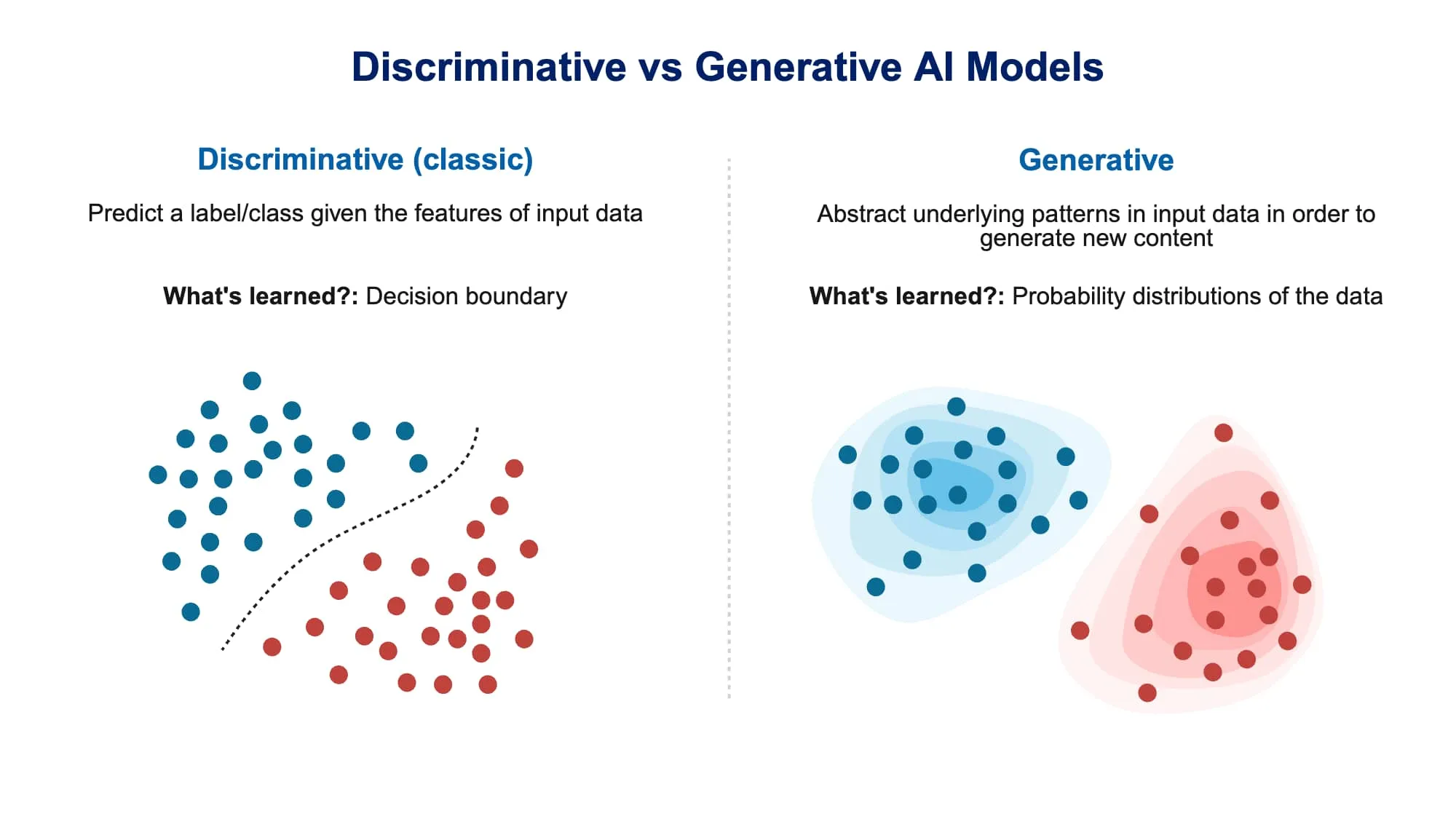
At their core, generative machine learning models aim to understand how data is generated. Instead of just learning the relationship between features and labels, these models attempt to capture the overall distribution of data, including the joint probability of inputs and outputs. In technical terms, a generative model tries to estimate the joint probability distribution P(X,Y)P(X, Y)P(X,Y), which lets it recreate new data samples that resemble the original dataset.
How Generative Models Work
Generative models identify the pattern and structure underlying the dataset. Once trained, these models can not only classify or predict outcomes, but also generate new examples based on learned data distribution. For instance:
- Predicting the next word in a text sequence
- Generating realistic images from noise inputs
- Producing synthetic data for training other AI models
This capability makes generative models particularly useful in creative AI, such as text generation, image synthesis, and data augmentation.
Examples of Generative Models
Some widely recognized generative models include:
- Naive Bayes Classifier – A probabilistic model that assumes feature independence and estimates likelihoods for classification.
- Hidden Markov Models (HMMs) – Used in sequence modeling by estimating transitions between hidden states.
- GANs & VAEs – Deep learning architectures designed for realistic data generation.
What Are Discriminative Models?
Unlike generative models that model the entire data distribution, discriminative models focus solely on learning the distinction between classes or outcomes. These models aim to identify the conditional probability P(Y∣X)P(Y \mid X)P(Y∣X), which directly estimates the likelihood of a label YYY given the features XXX.
How Discriminative Models Work
Discriminative models don’t attempt to understand how data was generated. Instead, they draw decision boundaries that separate different classes in the dataset. This focus makes discriminative models particularly powerful for classification and regression tasks where prediction accuracy is more important than modeling data distribution.
Examples of Discriminative Models
Common discriminative models include:
- Logistic Regression – Estimates probabilities for binary outcomes using a sigmoid function.
- Support Vector Machines (SVMs) – Finds optimal hyperplanes for class separation.
- Decision Trees and Random Forests – Tree-based methods that split data based on feature thresholds.
These models are often simpler to train and interpret than generative models, especially in typical supervised learning scenarios.
Generative vs. Discriminative Models: Core Differences
Below is a side-by-side comparison of key aspects where generative and discriminative approaches differ:
1. Probability Focus
- Generative: Model the joint distribution P(X,Y)P(X, Y)P(X,Y), learning how each class is generated.
- Discriminative: Learn the conditional distribution P(Y∣X)P(Y \mid X)P(Y∣X), focusing on the boundary between classes.
2. Use of Data
- Generative: Can generate new data, enabling tasks like data synthesis or simulation.
- Discriminative: Cannot generate new data; focused on prediction given existing data.
3. Computational Requirements
- Generative: Often require more computational resources due to modeling full distribution.
- Discriminative: Typically more efficient and faster to train.
4. Applications
- Generative: Useful in creative AI, unsupervised learning, and synthesis tasks.
- Discriminative: Best suited for standard classification and regression.
5. Robustness to Outliers
- Generative: More sensitive to noisy or outlier data.
- Discriminative: Generally more robust in real world scenarios.
When to Use Which? Practical Guidelines
Choosing between generative and discriminative models depends on the machine learning task and available data.
Use Generative Models When:
- You need to generate new data or simulate scenarios.
- Your dataset is limited and you want to model underlying structures.
- You’re working on unsupervised or semi-supervised tasks.
Use Discriminative Models When:
- The primary goal is high predictive accuracy in classification or regression.
- Efficiency and deployment speed are important.
- You have strong labeled datasets ready for supervised learning.
Conclusion
Both generative and discriminative machine learning models have their unique roles in the AI landscape. Generative models are powerful when understanding the entire data distribution and creating new samples is necessary. On the other hand, discriminative models offer speed, clarity, and strong performance for traditional prediction tasks. Understanding the differences and use cases for each helps data scientists choose the right approach for their projects.